


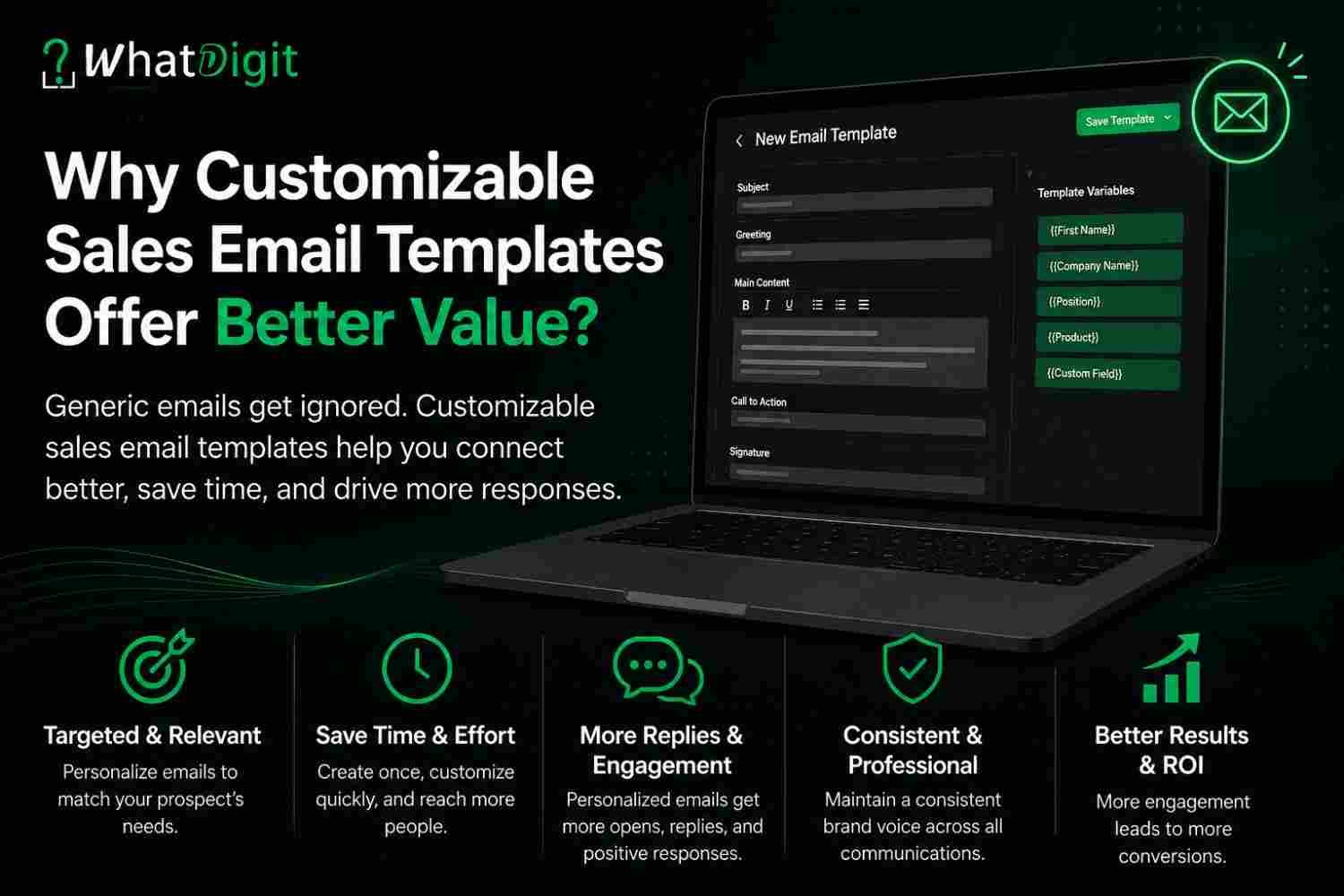
Customizable sales email templates offer better value because they combine speed with relevance. Instead of forcing every prospect into identical messaging, they let U.S. sales professionals adjust language, proof points, offers, and calls to action for specific audiences. This flexibility supports stronger brand consistency, faster campaign preparation, and more meaningful outreach.
A quality template also provides a reusable messaging framework without removing human judgment. However, templates cannot replace accurate targeting, credible offers, prospect research, or responsible sending. Their real value comes from helping teams create appropriate emails efficiently while preserving the context that encourages recipients to respond.
What Does Customization Mean in Sales Email Templates?
Customization means more than replacing a prospect’s name or company. A customizable template provides an editable structure that users can adapt by industry, buyer role, sales stage, business problem, offer, and communication style.
Strong templates separate fixed messaging principles from flexible content. For example, the email may retain a clear opening, concise value statement, credible proof point, and focused call to action while allowing the sender to change details. Consequently, representatives gain direction without sounding scripted.
Useful customization may cover:
Subject lines based on audience awareness or intent
Opening lines tied to relevant prospect research
Body copy aligned with specific business problems
Proof points suited to the prospect’s industry
Offers matched to company size or sales stage
Calls to action reflecting the desired next step
Tone adjustments for executives, operators, or owners
Follow-up language based on prior interactions
This structure creates a practical balance. The template reduces writing time, while the editable fields protect relevance and personal judgment.
Why Generic and Fixed Templates Often Lose Value
Generic templates may appear efficient because users can send them quickly. However, rigid wording often ignores the prospect’s role, priorities, buying context, and familiarity with the offer.
A message written for a small retail owner may not suit a SaaS executive or real estate professional. Similarly, an introductory cold email requires different language from a re-engagement message. When a fixed template treats these situations alike, recipients may view the message as irrelevant or automated.
Common limitations include:
Broad claims without supporting context
Openings that could apply to any recipient
Calls to action that demand too much commitment
Language that conflicts with the sender’s brand
Proof points that do not match the audience
Excessive length or unnecessary explanation
Limited options for different campaign stages
Formatting that becomes difficult to edit
Writing every email from scratch creates a different problem. Although original writing permits full control, it consumes time and can produce inconsistent messages across a team. Representatives may omit important details, use conflicting claims, or vary the offer unintentionally.
Customizable templates occupy the useful middle ground. They provide repeatable structure while keeping enough flexibility for thoughtful adaptation.
How Personalization Increases Practical Value
Personalization makes an email more relevant to the recipient’s likely priorities. However, effective personalization depends on meaningful context, not decorative details.
Personalization by Audience and Industry
Different audiences evaluate offers through different concerns. A startup founder may focus on cost, speed, and limited resources, while an enterprise account executive may prioritize integration, security, and internal approval. Therefore, senders should adjust the benefit statement and evidence accordingly.
Industry customization also matters. Recruitment teams, online retailers, consultants, and property professionals use different terminology and follow different buying cycles. A flexible template lets users replace generic language with recognizable problems, outcomes, and examples.
Before editing a template, the sender should identify:
The recipient’s role and likely responsibility
The company’s industry and operating model
A credible reason for contacting the prospect
The problem that the offer may address
The most reasonable next step
These inputs help the email sound specific without relying on invasive or unnecessary personal details.
Personalization by Sales Stage
Prospects require different messages as they move through a sales process. Cold outreach should establish relevance quickly, whereas lead-nurturing emails can build on prior interest. Meanwhile, follow-ups should add value instead of merely asking whether the recipient saw the previous email.
Customizable libraries often support:
Initial cold outreach
First and later follow-ups
Lead nurturing
Re-engagement
Referral requests
Meeting confirmation
Post-meeting communication
Proposal follow-up
Closed-lost reactivation
Customer expansion conversations
As a result, teams can maintain continuity across a sequence without repeating identical points.
Brand Voice and Message Consistency
A sales email represents the business behind it. Consequently, inconsistent tone, terminology, or claims can weaken trust even when the underlying offer has merit.
Customizable templates let teams establish approved messaging while allowing representatives to adapt relevant details. A business can define preferred language for its value proposition, positioning, evidence, and call to action. Salespeople can then personalize the surrounding message without changing essential facts.
This approach supports consistency in several areas:
Product or service descriptions
Approved benefit statements
Tone and level of formality
Terminology for customer segments
Proof and qualification language
Pricing or offer references
Meeting requests and next steps
Required compliance elements
However, consistency should not create uniformity at the expense of relevance. Every representative should retain enough flexibility to acknowledge the recipient’s context and respond naturally during an active conversation.
Time Savings Without Sacrificing Relevance
Templates save time by removing repeated structural decisions. The sender does not need to create every subject line, opening, transition, and call to action from an empty screen.
Instead, the representative can spend more time on activities that affect message quality, including prospect selection, account research, offer alignment, and follow-up planning. Therefore, the productivity gain comes from redirecting effort rather than eliminating effort.
A useful workflow includes four stages:
Select a template suited to the campaign objective.
Research the account and recipient.
Replace customization fields with specific information.
Review the complete email for clarity and accuracy.
Teams should never leave placeholders, irrelevant examples, or instructions inside a finished message. Moreover, senders should remove any sentence that does not contribute to relevance or the requested action.
Efficiency also improves when templates include optional versions. A representative may choose a concise executive variation, a problem-focused variation, or a warmer referral-based variation without rebuilding the entire message.
Reusability Creates Long-Term Financial Value
The purchase price represents only one part of template value. A reusable collection may support multiple campaigns, segments, offers, and team members over an extended period.
Businesses seeking to buy sales email templates online in USA markets should evaluate how many credible use cases the collection supports, rather than comparing products only by template quantity. Twenty adaptable frameworks may provide more practical value than hundreds of nearly identical messages.
Reusability matters because companies frequently change:
Audience segments
Service packages
Promotional priorities
Sales territories
Buyer objections
Proof points
Follow-up schedules
Calls to action
Customizable files allow teams to revise these components without discarding the underlying structure. Consequently, startups and small businesses can create an organized messaging system without maintaining a large enablement department.
Growing teams gain additional value because managers can standardize core messages before new representatives begin outreach. However, each employee still needs training on research, editing, judgment, and responsible sending.
Building Stronger Email Components
A valuable template collection treats each email component as editable and purposeful. Every section should help the recipient assess relevance or choose a reasonable next step.
Subject Lines and Opening Lines
Subject lines should accurately represent the email. Deceptive reply indicators, false urgency, misleading account notices, or exaggerated promises can damage trust and create compliance concerns.
Effective subject line options usually remain concise and connect to a relevant issue, request, or relationship. However, the best choice depends on audience familiarity, message purpose, and sender credibility.
Opening lines should establish context quickly. Instead of offering generic praise, a sender can mention a relevant business initiative, role responsibility, public company development, referral, or prior interaction. The observation must remain accurate and connect logically to the offer.
Body Copy and Proof Points
The body should explain why the email matters without overwhelming the recipient. Clear templates often present one recognizable problem, one relevant benefit, and one credible reason to continue the conversation.
Proof points require careful editing. Senders should use only accurate evidence that applies to the offer and audience. Additionally, they should avoid unsupported superlatives, invented results, or claims that imply certainty.
Useful proof may include:
A concise customer outcome with proper authorization
Relevant qualifications or operating capabilities
A short explanation of the process
A specific product or service feature
A verifiable business credential
A realistic example framed without fabrication
Template quality does not determine campaign performance by itself. Outcomes also depend on targeting, offer quality, timing, personalization, deliverability, and follow-up strategy.
Calls to Action
A call to action should request one clear and proportionate step. For an unfamiliar prospect, a short question may create less friction than an immediate request for a lengthy meeting.
Templates should offer alternatives for different stages, such as confirming relevance, requesting permission to send information, asking for a brief conversation, or identifying the appropriate contact. Consequently, representatives can match the request to the existing relationship.
CRM Workflows and Sales Automation Compatibility
Customizable templates create greater operational value when teams can use them within existing CRM and automation workflows. Compatibility may involve plain text, editable documents, spreadsheets, or formats that copy cleanly into sales systems.
Buyers should confirm whether the collection supports:
Clearly labeled personalization fields
Clean formatting after copying
Mobile-friendly email structure
Sequence organization
Editable subject line options
Notes explaining intended use
Multiple versions for testing
Easy collaboration and approval
Common merge-field conventions
Storage in shared template libraries
Automation can distribute approved messages and schedule follow-ups. However, it should not remove human review where context matters. For example, a high-value account, sensitive conversation, or complex offer may require individual writing.
Teams should also test merge fields carefully. Incorrect names, company details, capitalization, or fallback values reveal automation and may harm credibility.
Collaboration, Approval, and Onboarding Benefits
Templates give sales managers, marketing teams, and compliance reviewers a shared starting point. Therefore, collaborators can review the structure, claims, tone, and required disclosures before representatives use the messages.
A controlled library also reduces version confusion. Teams can assign owners, label approved versions, record revision dates, and retire outdated messages. Meanwhile, feedback from representatives can identify common objections or unclear language.
For onboarding, templates demonstrate how the organization communicates with different audiences. New hires can see approved examples of prospecting, follow-up, nurturing, and referral messages. However, managers should teach the reasoning behind each framework rather than encouraging mechanical copying.
Useful governance practices include:
Assigning an owner to each template
Recording the intended audience and purpose
Protecting approved factual claims
Marking optional personalization areas
Reviewing performance and feedback regularly
Removing outdated offers or evidence
Restricting unapproved mass distribution
Training users to proofread every message
Testing and Continuous Performance Improvement
Customizable templates make controlled testing easier because teams can change one major element while keeping other elements consistent. This approach helps users identify which version performs better within a specific campaign.
Teams may test:
Subject line approach
Opening sentence
Message length
Value proposition
Type of proof
Call-to-action wording
Follow-up timing
Level of personalization
However, testing requires enough comparable activity to support a useful conclusion. Small differences from limited sends may reflect chance, audience variation, or timing. Therefore, teams should avoid declaring a universal winner too quickly.
Performance measures should also reflect the campaign objective. Opens may provide limited insight, while replies, qualified conversations, scheduled meetings, or progression through the sales process may offer more useful signals.
Additionally, teams should separate positive replies from objections, removals, and automatic responses. A higher reply count does not necessarily indicate stronger commercial value.
Deliverability and Responsible Sending
No template can compensate for poor list quality or irresponsible sending. Businesses should contact suitable recipients, maintain accurate sender information, monitor delivery problems, and honor opt-out requests.
Spam-like patterns often include excessive sending, copied language with no relevance, misleading subjects, unnecessary capitalization, repeated punctuation, or unsupported urgency. Consequently, customization can support deliverability by encouraging varied, contextually appropriate messages, but it does not guarantee inbox placement.
Responsible practices include:
Using accurate and lawfully obtained contact data
Identifying the sender and business clearly
Avoiding deceptive routing or subject information
Providing required opt-out mechanisms
Processing removal requests promptly
Monitoring bounces and invalid addresses
Limiting outreach to relevant audiences
Protecting personal and customer information
Reviewing automation settings before activation
U.S. commercial email campaigns may fall under federal and state requirements, platform policies, contractual obligations, and industry-specific rules. Businesses should obtain qualified legal advice for their circumstances. Templates should include editable areas for required business details and compliance language without presenting generic wording as universally sufficient.
What Buyers Should Evaluate Before Purchasing
A high-quality collection provides useful structure, clear editing options, and realistic messaging. Quantity alone offers little evidence of value.
Licensing, Rights, and File Access
Buyers should verify whether the license permits use by one person, an internal team, client accounts, or an agency. They should also check whether modification, duplication, and commercial campaign use remain permitted.
Important questions include:
Can multiple employees use the files?
May an agency adapt them for clients?
Does the license restrict redistribution or resale?
Which file formats come with the purchase?
Can users edit every message?
Does the product require special software?
Are future updates included?
How does the seller deliver revised versions?
Can buyers retain access after downloading?
Does a clear refund policy apply?
Plain, editable formats often provide greater longevity than locked files. Moreover, buyers should confirm that formatting survives copying into their preferred systems.
Quality Indicators and Warning Signs
Strong collections explain the purpose, audience, and sales stage for each message. They also include meaningful variations rather than superficial word changes.
Positive indicators include:
Clear organization by use case
Natural, concise American English
Specific customization instructions
Multiple audience or tone options
Credible calls to action
Space for researched details
Ethical follow-up language
Testing suggestions
Editing notes
Update information
Warning signs include guaranteed outcomes, fabricated statistics, misleading subject lines, vague usage rights, locked formats, excessive hype, and emails that require little prospect context. Buyers should also question enormous libraries filled with repetitive messages. Such collections may increase search time while offering limited strategic variety.
A Practical Pre-Purchase Checklist
Before purchasing, buyers should assess fit, usability, and long-term application. The following checklist supports a balanced decision:
Define the campaigns and sales stages that need support.
Confirm that examples match the intended U.S. audience.
Review sample language for clarity and credibility.
Check whether every important component remains editable.
Assess the depth of personalization instructions.
Compare distinct frameworks, not headline quantities.
Verify file formats and CRM compatibility.
Read licensing terms and team-use restrictions.
Check update, access, and support policies.
Reject unsupported performance promises.
Confirm that compliance fields can be adapted.
Estimate time saved across repeated campaigns.
Consider approval, onboarding, and collaboration benefits.
Identify situations that still require original writing.
Evaluate whether the collection supports responsible outreach.
The best choice should fit the team’s actual workflow. A low-priced product creates poor value if employees cannot edit, organize, approve, or reuse it efficiently.
When Templates Fit and When Original Writing Works Better
Templates work well for repeatable communication with identifiable patterns. Examples include standard prospecting campaigns, routine follow-ups, event outreach, referral requests, re-engagement efforts, and common lead-nurturing sequences.
Fully original writing usually works better when:
The account carries unusually high strategic value
The situation involves sensitive or confidential details
A complex proposal requires substantial context
The recipient has raised specific objections
An active negotiation has begun
A relationship requires highly personal communication
The offer falls outside established positioning
The message responds to a unique business event
A hybrid approach often provides the strongest balance. The sender can use an approved framework for structure, then rewrite major sections around the account’s circumstances. Therefore, teams should treat templates as adaptable tools, not finished messages that require no judgment.
Conclusion
Customizable sales email templates provide better value when they help teams communicate faster without reducing relevance. Their flexibility supports brand consistency, audience-specific messaging, collaboration, testing, and reuse across campaigns. However, value depends on editable formats, practical licensing, credible language, workflow compatibility, and disciplined personalization. Templates cannot fix weak targeting, poor offers, careless automation, or irresponsible sending.
Businesses should choose adaptable frameworks that support human judgment and accurate communication. When teams combine sound templates with research, review, and measured improvement, they gain a durable sales resource rather than a collection of disposable scripts.
FAQs
What makes a sales email template customizable?
A customizable sales email template contains editable sections for the audience, problem, offer, proof, tone, and call to action. It may also include personalization fields and optional variations. Users should be able to adapt the message substantially without weakening its structure, clarity, or intended purpose.
Are customizable templates better than free templates?
Customizable paid templates may offer better organization, editing instructions, licensing clarity, and use-case coverage than free alternatives. However, price does not prove quality. Buyers should compare message credibility, distinct frameworks, file access, usage rights, update terms, and suitability for their workflow before deciding.
Can sales email templates improve response rates?
Templates can support better responses by improving clarity, consistency, relevance, and follow-up discipline. However, they cannot guarantee replies. Performance also depends on list quality, targeting, timing, offer strength, personalization, sender reputation, deliverability, and whether the requested next step feels reasonable to the recipient.
How much personalization should a sales email include?
A sales email should include enough personalization to establish a credible reason for contact. Usually, one meaningful observation connected to the recipient’s role, company, or current priority provides more value than several decorative details. Every personalized statement should remain accurate, relevant, respectful, and logically connected to the offer.
Can small businesses use templates designed for larger teams?
Small businesses can use the same core frameworks, but they should adapt approval steps, tone, proof, and automation levels to their resources. A founder-led operation may prefer personal language and manual sending, while a larger team may require shared libraries, permissions, governance, and formal version control.
What should buyers check before purchasing a template collection?
Buyers should review sample quality, customization depth, intended use cases, file formats, editing access, CRM compatibility, licensing terms, update policies, and team-use rights. They should also reject products that promise guaranteed outcomes, rely on deceptive language, or provide large quantities of repetitive messages with little strategic difference.
Do customizable templates work with CRM systems?
Many customizable templates work with CRM systems when they use clean formatting, clear merge fields, and editable text. However, compatibility varies by file type and workflow. Buyers should confirm copying behavior, personalization syntax, sequence support, mobile formatting, fallback values, and any software requirements before purchasing.
Can one sales email template support multiple industries?
One template can support several industries if its structure addresses a broadly shared sales situation and allows substantial editing. However, users must change terminology, problems, proof points, benefits, and objections for each market. A framework may transfer across industries, but an unchanged message rarely provides equal relevance everywhere.
How often should sales teams update their templates?
Sales teams should review templates regularly and whenever offers, positioning, audiences, regulations, or proof points change. Performance feedback may also reveal weak openings or calls to action. Teams should record revision dates, assign owners, retire outdated versions, and avoid changing messages solely because of short-term fluctuations.
Are sales email templates suitable for every prospect?
Sales email templates do not suit every prospect without substantial adaptation. High-value accounts, sensitive situations, negotiations, unusual objections, and established relationships often require original writing. In those cases, a template may still provide structural support, but the sender should prioritize context, accuracy, judgment, and natural communication.
Comments (0)